
Avatar: The Last Airbender's The Rift, Explained With Every Big Spoiler
Toph's dad has notes.
Anthony Bruno
Spoiler warning. This breakdown covers all three parts of The Rift, ending included.
As an Amazon Associate, Church of Nerds earns from qualifying purchases. Buying through the Amazon links in this post supports the site at no extra cost to you.
The Promise was Zuko's story about the future of the Fire Nation, and The Search was Zuko's story about his mother. The Rift finally hands the spotlight to Toph. It's the third book on our list of Avatar comics set between the show and Korra, and it picks up after The Search with Aang trying to bring back an Air Nomad holiday nobody has celebrated in over a century.
Dark Horse released The Rift in three parts in 2014, starting in March and wrapping up in November (Avatar Wiki). Gene Luen Yang wrote it again, the art team Gurihiru drew it again, and Part One went straight to number one on the New York Times bestseller list (Dark Horse).
What is Yangchen's Festival?
The story opens in Yu Dao, the colony from The Promise, where a new coalition government with two Earth Kingdom and two Fire Nation leaders is taking over. During the ceremony, Aang sees the spirit of Avatar Yangchen, the Air Nomad Avatar who came before Kuruk. She points toward the mountains and vanishes before he can hear what she's saying.
Aang decides she wants him to revive Yangchen's Festival, an old Air Nomad holiday, so he packs up the gang and his Air Acolytes and flies to the sacred meadow where it used to happen. The problem is that the meadow has turned into a busy town, with a polluted river and a giant factory built right on top of the holy ground (Avatar Wiki).

Why do Aang and Toph fight?
The factory is the Earthen Fire Refinery, a joint business between a Fire Nation man named Loban and an Earth Kingdom businessman who turns out to be very important later. It employs benders from every nation working side by side with nonbenders, and Loban's nephew Satoru, a nonbender engineer, keeps the machines running.
Aang sees a factory desecrating sacred Air Nomad land. Toph sees exactly the kind of world the war was fought for, with people from every nation building something together. She also refuses to bow to Yangchen's statue, since bowing reminds her of every stiff ritual her parents forced on her as a kid. That argument is the real rift of the title, and it's the most interesting fight the comics have given these two (Sokka mostly just wants lunch).
What happens when Toph sees her father?
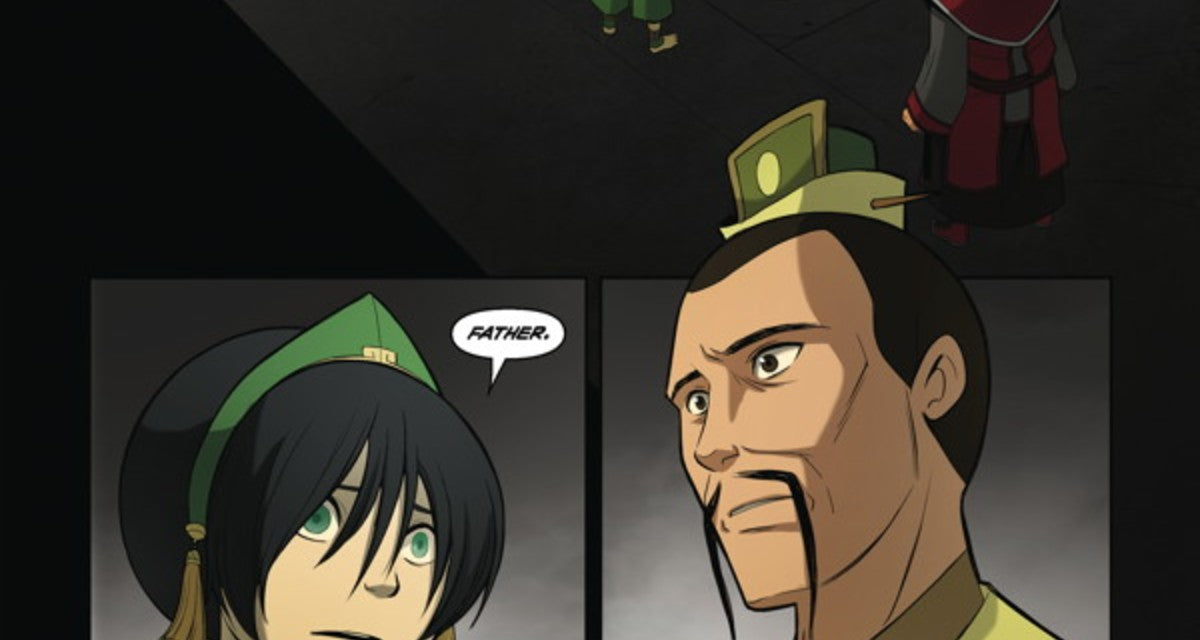
Part One ends with a gut punch. The refinery's Earth Kingdom partner is Lao Beifong, Toph's father, and she hasn't seen him in two years. Part Two is where it really hurts. Lao refuses to acknowledge her at all. He tells her he raised a "poised, demure, obedient" daughter, and the loud girl standing in front of him is a stranger (Avatar Wiki).
Toph tells him that the quiet act was never the real her and that she's the greatest earthbender alive. He turns his back on her anyway, and she walks away deciding the whole visit was a mistake. Seeing the toughest character in Avatar get shut down by her own dad is one of the saddest moments in any of the comics.
Who is General Old Iron?
While Toph deals with her father, Aang reaches Yangchen in the Spirit World and finally gets the backstory. On her first mission as Avatar, Yangchen faced General Old Iron, a huge armored spirit who wanted revenge on humanity after his protector, Lady Tienhai, died. Yangchen stopped him and made a deal to keep the peace, and the festival was created to honor it. The exact terms were lost during the Hundred Year War (Avatar Wiki).
Meanwhile, Sokka and Katara find out what's really poisoning the river. Loban has been running a secret iron mine under the town behind Lao's back, and it's also causing the earthquakes. Then the mine collapses with Katara, Toph and the workers inside, and Toph's metalbending is the only thing keeping the ceiling up.
How does Toph get out of the mine?
Part Three opens with the rescue. Aang gets Toph's three metalbending students to dig everyone out by bending the iron in the ground. While they wait, Lao, convinced he might die down there, finally tells Toph he loves her and is sorry. He explains that after she ran away, the search for her was called off, his marriage to Toph's mother, Poppy, fell apart, and he left Gaoling. Toph answers in the most Toph way possible, saying they won't die because she's the greatest earthbender of all time (Avatar Wiki).
Then the big reveal lands. The "iron ore" Loban has been mining is actually General Old Iron's discarded armor, including a giant mask. When Loban tries to haul it off and sell it, the spirit comes back for it.
How does The Rift end?
Aang decides he has to destroy the refinery to restore the land and keep Old Iron away, and Toph and her students stand in his way. The two friends actually fight until Old Iron shows up and forces them onto the same side. Toph's students peel the spirit's armor off piece by piece, and when Old Iron turns on them, Aang goes into the Avatar State and hits his exposed chest with all four elements. The spirit admits humans have overwhelmed spirits and sinks into the ocean (Avatar Wiki).
Afterward, Lady Tienhai visits Aang and tells him spirits never truly die, they just change form. She also tells him that humans can choose to create rather than dominate, and spirits will have a place as long as people make room for them. Three months later, Aang turns the old holiday into the Spirits' Friendship Festival, Toph and Satoru are running a new factory together, and Loban has joined the Air Acolytes (a big career change).
Is The Rift worth reading?
My read is that The Rift is the most underrated of the first three Avatar trilogies. The Toph and Lao story is the heart of it, and it gives her the family closure the show never had time for. Watching her still want her dad's approval after everything is a lot to handle for a character who usually solves her problems with a rock.
It also matters for the bigger Avatar story. The fight between Aang's respect for the old ways and Toph's faith in progress is basically the whole setup for Republic City and The Legend of Korra, and Gene Yang has said the Yu Dao coalition was meant to point toward Korra's United Republic Council (Avatar Wiki). The Old Iron fight is the weakest part, and Loban is a pretty flat villain. Still, Gurihiru's art is beautiful, and the emotional beats land.
If you want to read it, The Rift Omnibus collects all three parts in one paperback. If you're reading in order, start with The Promise and The Search, then keep going with Smoke and Shadow.
- Avatar: The Last Airbender, The Rift Omnibus
- Avatar: The Last Airbender, The Search Omnibus (the one before)
- Avatar: The Last Airbender, Smoke and Shadow Omnibus (next in the series)
Next up on our list is Smoke and Shadow, where Zuko deals with a secret society trying to take his throne.
More Avatar coverage is right here.
Header image shows the covers of The Rift Parts 1 to 3 from Dark Horse Comics, art by Gurihiru. In-article panels are from Dark Horse's official previews.


